Showing posts with label awakening. Show all posts

Friday, September 30, 2011

India Against Corruption

1. Introduce state-funding as part of election reforms:

The high cost of elections and candidates' dependence on money, often of questionable provenance, compromises them from the very outset. Once beholden to moneybags, they are under obligation to return the favour if they win. Of course, not all candidates can be funded by the state. So, we suggest that only candidates belonging to national parties receive election money from the state. In this too we can pare down eligibility by regions. For instance, the CPM might be a "national party" but its influence is largely limited to Bengal, Kerala and Tripura. Its candidates getting funding in any other state should depend on its performance in that state in the previous election. By the same token, state parties must get funding in their specific states, like the BSP in UP or the BJD in Orissa.

2. A reasonable and transparent tax structure, backed by clean and clear enforcement:

Our direct taxes (personal income and corporate) are no longer unreasonable, so there's little excuse for trying to evade them. But there is an unhealthy trend in piling on surcharges on various pretexts. Also, there are tons of other taxes that can add up to quite a bit. Finally, there's the larger question of how efficiently and honestly taxpayers' money is put to use - when you see the state of government hospitals and schools, and rotten roads, you wonder where the money you paid as tax has gone

3. Liberal and contemporary laws that citizens can understand and respect:

People find it difficult to accept ridiculous, outdated and moralistic laws - worse, they may not even be aware of some of these laws till some law enforcer somewhere decides to use them to harass and to extract money. Once you dismiss a law or rule as stupid and worthy of breaking (like not allowing drinking under 25 years of age), there's a human tendency to take other laws less seriously. Therefore, to the extent possible, there's a need to cut back on the multiplicity of unnecessary and complex laws, and zero in on just the ones that are needed to ensure a fair, equitable and just system. These should then be administered without fear or favour.

4. Reduce the role of the state in people's lives to the absolutely essential:

In some ways, this is related to our earlier point. The greater the scope for state interference - be it the police or the clerk in a government office or the customs inspector - the greater the scope for harassment and graft.

5. Genuine autonomy for the public/government sector:

Big PSUs - think Air India, for instance - place huge contracts. Even a fraction of that is huge money in absolute terms. There is always a temptation for political bosses to exert their influence and swing the contract for chosen ones and receive handsome kickbacks. So get them out of the day-to-day functioning of these PSUs.

6. Minimize discretionary powers of ministers and bureaucrats:

This would reduce scope for misuse of such powers to favour some -->

7. Pay government and PSU officers, judges and policemen market-indexed salaries commensurate with their responsibility:

This would minimize the 'need' for bribes. Their salaries could be benchmarked against corporate sector salaries. But higher salaries should be combined with exemplary punishment, including dismissal from service and a police case if an employee is caught indulging in corrupt practices. Mere transfer or suspension won't do.

8. Introduce sweeping police reforms and stronger judicial accountability:

This has been discussed for decades but there's been no action. The recommendations for reforms are already there. Set a time frame for implementation. This will make the police not just a professional force that's not at the beck and call of politicians, but also a trained one with in-built checks against developing vested interests. Today the situation often is that the investigator (police officer) is answerable to the person being investigated (politician). Also, separate the police into two wings: one for investigation and the other for maintaining law and order. The two functions are different and require different skill sets. Sadly, the image of the judiciary has taken a knock in recent years - for the common man, the courts are the last resort for seeking justice.

9. Blacklist corrupt businessmen:

Private businesses caught indulging in corrupt practices or bribing officials should be blacklisted for, say, 10 years and be barred from government projects. In the category of corrupt practices would fall use of shoddy material -- like road contractors who give one inch of tar when they are supposed to give four inches and the road crumbles after one monsoon. Bigger instances of private businesses cutting corners in public projects by colluding with corrupt officials should attract exemplary punishment.

10. Transparency and stricter scrutiny of government tenders/orders, including auction/sale of public-owned assets:

Hundreds of thousands of crores of orders are placed every year by government departments, PSUs, municipal corporations and the like. Its common knowledge that tenders are often awarded on considerations other than merit. This is one of the biggest sources of corruption in the country. And don't forget, this is taxpayers' money that is being diverted illegally.

Finally, and this is for every one of us, let's try and say no to bribes. This is the right moment to unleash a national campaign against giving bribes as the mood against corruption is high. Ultimately, we can't get rid of the bribe taker if we are willing to be bribe givers.

Corruption related complaints including audio, video clips can be lodged at VIGEYE portal on the CVC website http://cvc.nic.in

Thursday, June 9, 2011

Water Conservation through Nagpuri Weirs


Water Conservation through Nagpuri Weirs (An Innovative Scheme bv Zilla Parishad - Nagpur) Nagpuri Weir is an innovative Minor Irrigation Structure made of empty polythene cement bags filled with mixture of sand and soil with pasting of black cotton soil in between. The idea has been originally conceived by NGO 'Vanrai' but successfully implemented by the Zilla Parishad, Nagpur.

Here is the success story of this innovative experiment.
Nagpuri Weir is a Low cost structure of which minimum cost is Rs.500/- Technology used is very simple and users friendly. Rainwater in smaller streams surrounding any village can be checked if we have a series of such weirs in the stream bed. Construction of such weir requires empty cement bags and the remaining material is available on the banks of the stream. A weir of 8 meter width requires 177 empty cement bags of which cost coupled with the mandays is not more than Rs.781/- The most important features of this structure is that the material is locally available and people themselves can construct it without any technical know-how.

Average rainfall of Nagpur district is 1000 mm. But 30 to 40% of the rainwater drains away un-utilized. There is large number of Minor Irrigation structures like K.T. weirs, storage tanks, "malgujari" tanks in Nagpur district. But maintenance of these structures is a herculean Task in itself and they hardly serve their original purpose. Therefore, Zilla Parishad, Nagpur decided to experiment with still lower cost and more people oriented structures for conservation of rainwater. They took up to Nagpur weir ( Originally known as Vanrai Bandhara) as the major activity during watershed week to be celebrated from October 1 to 7, 2001. Generally, water conservation activities are looked after by State Agriculture Department. But Government of Maharashtra decided to involve Zilla Parishads Block level machinery such as Deputy Engineers (Ml), BDO's, Agriculture Officers, Village Officers etc. in the programme. They were to be guided initially by State Agriculture Department Officers.


A workshop was arranged to that effect on 18th September 2001 and the concept of a cement bag weir was explained in detail. It was decided to have at least 10 such weirs in each of all 13 blocks during watershed week. There was no financial provision for that. It was to be implemented as peoples programme. NGO Vanrai responded positively to our enthusiasm and offered empty cement bags which were required. Initially tanker-fed villages were selected for this activity. Later on other villages also participated. People and school children came forward for "Shramdan." At many places Panchayat Samiti Officers themselves made Shramdan and constructed such weir. Vanrai provided more than 1 lack cement bags and remaining were collected by village panchayats.


As a result, from October 1st to December 31st 2001about 425 Nagpuri weirs were constructed in 310 villages without spending any Government money. Total rainwater stored by these weirs was 700 TCM for which, otherwise we would have required to construct almost 35 cement weirs and spent not less than Rs. 70 lakh. As it is a low cost and less time consuming structure Government of Maharashtra would take more Nagpuri weirs in lesser time period in a scattered area. More than 300 villages out of total 1600 villages in Nagpur district are benefitted by this experiment. Water level of the nearby Irrigation as well as water supply wells has increased. Farmers could take rabbi crops through direct irrigation from the weirs. In some of the Nagpuri weirs local fishermen started fishing activity.


Success stories are always made by sheer hard work, systematic efforts and team work. Nagpuri weirs is one such success stories which is made because of wonderful coordination among various wings of Zilla Parishad Nagpur, spontaneous response from the people, their participation in the form of money and labour, involvement of NGO's and supervision and motivation by higher officials.


Government Of Maharashtra has taken due notice of this experiment and taken it up as their regular activity. I hope that this success story will be repeated in all other districts of Maharashtra this year as the monsoons are here.

Friday, February 5, 2010

ConserveEnergy

Conserve Energy


One thing that has been really frustrating me for the past few days is the rising electricity bills, although the usage is almost the same. We all as humans tend to get all the luxuries in life but forget that getting those luxuries also takes us one step closer to self destruction. I myself was not energy conserving but 2 days earlier in Ghatkopar (west)Mumbai, I found the whole street lit up in the afternoon and I thought that, 'there are people who are facing problems on load shedding and here the street is lit up when not needed. I've decided to save the smallest amount of energy as possible to safe guard our own future.

The Government of India set up Bureau of Energy Efficiency (BEE) on 1st March 2002 under the provisions of the Energy Conservation Act, 2001. The mission of the Bureau of Energy Efficiency is to assist in developing policies and strategies with a thrust on self-regulation and market principles, within the overall framework of the Energy Conservation Act, 2001 with the primary objective of reducing energy intensity of the Indian economy. This will be achieved with active participation of all stakeholders, resulting in accelerated and sustained adoption of energy efficiency in all sectors
.


Role of BEE


BEE co-ordinates with designated consumers, designated agencies and other organizations and recognize, identify and utilize the existing resources and infrastructure, in performing the functions assigned to it under the Energy Conservation Act. The Energy Conservation Act provides for regulatory and promotional functions.


Regulatory


The Major Regulatory Functions of BEE include:


>>
Develop minimum energy performance standards and labeling design for equipment and appliances.

>>
Develop specific Energy Conservation Building Codes.


>>
Activities focusing on designated consumers.


>>Develop specific energy consumption norms.


>>Certify Energy Managers and Energy Auditors
.

>>Accredit Energy Auditors
.

>>Define the manner and periodicity of mandatory energy audits.

>>
Develop reporting formats on energy consumption and action taken on the recommendations of the energy auditors
.


Promotional


The Major Promotional Functions of BEE include:


>>Create awareness and disseminate information on energy efficiency and conservation
.

>>Arrange and organize training of personnel and specialists in the techniques for efficient use of energy and its conservation
.

>>
Strengthen consultancy services in the field of energy conservation
.

>>Promote research and development


>>
Develop testing and certification procedures and promote testing facilities


>>
Formulate and facilitate implementation of pilot projects and demonstration projects


>>
Promote use of energy efficient processes, equipment, devices and systems


>>
Take steps to encourage preferential treatment for use of energy efficient equipment or appliances


>>
Promote innovative financing of energy efficiency projects


>>
Give financial assistance to institutions for promoting efficient use of energy and its conservation


>>
Prepare educational curriculum on efficient use of energy and its conservation


>>
Implement international co-operation programs relating to efficient use of energy and its conservation


#How can we save energy in our day to day life?


>>Turn off lights when not in use


>>
Clean the dust accumulated on tube lights and bulbs and its fixtures regularly.


>>
Use ISI marked electrical appliances and equipments


>>
Place your tube lights and bulbs in positions where the light is not obstructed.


>>
Use CFLs to save energy


#Why CFLs?


Compact fluorescent bulbs (CFLs) use about two-thirds less energy than incandescent bulbs with no reduction in quality of light. Compact fluorescent bulbs will give an incandescent bulb's warm, soft light, while using up to 75 percent less electricity


CFLs are slightly costlier but are worth investing as they are smaller, cheaper, brighter, and offer improved color quality. Typically, a 23-watt compact fluorescent bulb can replace a 90- or 100-watt incandescent bulb


Use compact fluorescent bulbs in fixtures that are on for more than four hours a day. By replacing only two 75 Watt light bulbs that are on four hours a day by two 15 watt energy-saving lamps, you can save almost 18 Kilo Watt hours per year.


Less Energy More Light


#While Cooking

>>Use energy efficient chulas


>>
Keeping the vessels closed with a lid while cooking reduces cooking time and energy use.


>>
Soak the food ahead of cooking.


#During agricultural activities


Irrigation


Pumping out water


There is a potential of about 25% to 35% improvement in the efficiency of these pump sets by affecting minor/major rectification and shifting to ISI marked pumps.


>>The larger valve helps to save electricity / diesel because less fuel and power is needed to draw water from the well.


>>
The fewer the no. of bends and fittings in a pipe, more the electricity saves.


>>
Sharp bends in the pipe leads 70 % more frictional loss than standard bends.


>>
A farmer can save 15 liters of diesel every month simply by reducing the pipe height by 2 m. The pump works more efficiently when it is not more than 10 feet above the water level of the well.


>>
Use good quality PVC suction pipe to save energy and save electricity up to 20 %.


>>
Apply oil and grease to pump set regularly as recommended by the manufacture.


>>
To improve the power factor and voltage use ISI marked shunt capacitor of right capacity with motor. This will also save the electricity.


>>
Switch off the light of well in the day time.


#While using google


If we are little bit conscious about energy savings and keep proper vigil on this with discipline than we will save a lot through n number of resources which consume energy. In Continuous with the same follow up if we use www.googleblacksearch.com for day to day search on the web, than it will save lots of energy which can be reused in other required places.


www.GoogleBlackSearch.com is powered by Google Custom Search since this is same as google so you will loose nothing but at the same time you save lots of energy.


Benefits by using www.GoogleBlackSearch.com (Energy Saving Search Engine) are as follows :


>>Saves lots of energy as a black screen uses less energy than a bright white one.


>>
Less stress on your eyes when you are working for long time. So it save you eye too.


So start using www.GoogleBlackSearch.com (Energy Saving Search Engine) and start saving energy every time you search on the Internet.

Sunday, October 4, 2009

Stop use of Plastic

Stop Use of Plastic


An incident at a shopping mall inspired me to write this post.
I had been to a shopping mall in Powai where I was standing in line at the pay counter to pay for the stuff I had taken. An elderly woman was standing right in front of me and was checking her stuff at the counter, the receptionist at the counter filled her belongings in 3 plastic bags and gave it to her. The women refused to take the plastic bags and gave her cloth bags and asked the receptionist to put her belongings in those bags. Seeing those cloth bags I was so amazed and happy that I actually thanked her for using such cloth bags and since I had little stuff to carry I asked the receptionist to arrange me a paper bag instead of the plastic one, which she did.

Mumbai produces 7,800 tons of garbage daily - 40 tons of which is plastic.
Our city being near to the coastline all our sewage goes into the nearby Arabian Sea.
The plastic reaching the sea has catastrophic effect on the marine life.
Different species of sea life including whales, dolphins, seals and turtles die due to plastic bags.
They die after ingesting plastic bags which they mistake for food. The fish sometimes do not die but get poisoned and when such fish comes to the local market the person consuming such fish suffers from food poison.
In large number of cases it sadly results to death.


In today's competitive market there has been a rise in the number of malls and more consumers are switching over to malls and fresh food chains for household shopping which has led to drastically high use of plastic bags. The plastic bags is banned under the
Recycled Plastics Manufacture and Usage Rules, 1999 (amended 2003-2006), and various state rules.
Thick bags also have their own set of problems as thick plastic bags are the most difficult to degrade.It cost more to recycle a bag than to produce a new one.

Since plastic is not degradable it collects on the dumping grounds resulting in wastage of land as the ground cannot be further used for other activity.Use of plastic is not only bad for our city but is an global issue. Countries all over the world have have taken steps to reduce use of plastics by either banning or taxing use of plastic.Bangladesh has banned plastic bags, Ireland took the lead in Europe, taxing plastic bags in 2002. In 2005 Rwanda banned plastic bags and has now reduced plastic bag consumption by 90%.

It is our responsibility as learned citizens of our country to limit the use of plastic bags as far as possible. We should ourselves not use such plastic bags and encourage our near ones to stop use of these bags.

Things we can do as responsible citizens of our country:

>> Do not use plastic bags at all and encourage our near ones to stop the use of plastic bags.

>>
Retailers do not pay attention to eco-friendly aspects. Consumer education is missing. So if you do not ask for plastic bags they will not give you one. And if they give you one, refuse it and tell them that there is a fine and it is banned!

>>
We should carry our own bags before going to the market or for shopping.

>>
If you happen to see plastic bags lying around dispose them off in the bins which will be hopefully segregated later and not end up in the rivers or choke the drainage system.

>>
If you are a retailer you can also set up state-of-the- art recycling centres.

>>
Big Shopping complexes where the maximum reach can be aimed at; paper, jute, even cloth bags and other materials which are biodegradable can be promoted.

>>
Encourage students to make and use cloth /paper bags.

Enforcement of the Maharashtra Plastic Carry Bags (Manufacture and Usage) Rules 2006 also comes under the purview of the State Pollution Control Boards, the industries department and the district collector.

Clean Mumbai Green Mumbai


Lets make our city a better place to live in.


Thursday, September 3, 2009

Swine influenza Awareness

Swine Influenza Awareness
swine flu
Lately I was very disturbed by the fact that people are acting so foolishly in response to the lately discovered h1n1 virus.
Swine Flu virus is a serious issue that needs practical precautions to be taken by individual to avoid the epidemic.

I could not understand what the chaos is about, 'Swine Flu' is same as another other flu. Thousands of people die because of
malaria, dengue, AIDS and many other deadly diseases but no one pays heed to them.

Writing this post I recollected my friend saying, Hundred people have swine flu and everyone wants to wear a mask, Crores of people have
AIDS and no one wants to wear a condom.

Swine Influenza (swine flu) is a respiratory disease of pigs caused by Type A influenza viruses that causes regular outbreaks in pigs.

Swine flu viruses have been reported to spread from person-to-person, but in the past observations,
this transmission was limited and not sustained beyond three people

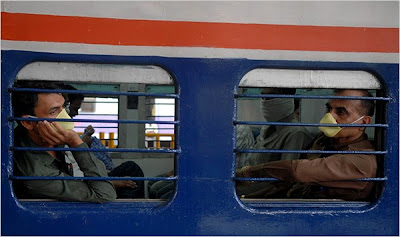
>>People in Mumbai are using safety mask which are not N75 swine proof mask which will avoid the virus and increase safety.
They purchase general mask from chemist and other stores which are high on sale, selling about 300 times more than the cost.

>>People cover there nose and mouth with handkerchief, and while boarding and getting down of local trains and bus,
they touch the side handles and handles at top and other places which can be more dangerous source for swine flu.

>>Upon touching/holding in such public places in train, they use the same unwashed hands and use handkerchief…
Now practically chances are more that the handkerchief is affected with h1n1 virus.

>>People wearing handkerchief on mouth/nose, It will just create suffocation friends and is not going to help.
Because of this epidemic panic people are ignoring and staying away from people who just yourning and sneezing in general.

>>There are also some fools who upon seeing any person wearing mask, start believing that the person is affected by H1N1 swine flu and just walk at some distance.


The Symptoms of Swine flu are:


Cough, Fatigue, Head and Body Ache, Nausea, Sore Throat,
Chills, Diarrhea, Fever and Vomiting.


Precautions that can be taken to avoid the virus and increase safety are as follows:


>>Do not talk more keeping your mouth open in public places you feel is very crowded and lots of pollutions around.


>>Wash Hands Before Touching Any Eatables.


>>Avoid road side junk food and eatables, this helps you avoiding swine flu.


>>Help boost your immune system by some multi vitamins and home remedies and Ayurveda herbs.


>>Drink plenty of water.


>>Get plenty of sleep at least 8 hours a day.


>>Immediately check yourself if you get some symptoms of flu.


>>If you feel weak, take proper rest for a day or two, as lower immune can welcome the flu.


>>If swine flu confirmed, then try isolating yourself from others and keep things like handkerchief and Other basic daily things separate in family.


Please note:

Tamiflu (drug used for treatment of swine flu) should be avoided till swine flu is confirmed, as overdose of drug is known to cause side effects especially with the children below five years of age

Saturday, June 27, 2009

Stop Child Labour

Stop Child Labour
Stop child labour
How would you feel if were asked to do rigorous work for 8-12 hours and treated like a slave?
This is the condition of many Children in India. Those tiny hands work hours and hours just for a one time meal. These children get forced to work not just for them selves but for their younger parts too. A 12 year old boy working at a construction site to feed his younger sister of just 5 years!!! How does that feel to you? It is a shame on our part that we home the largest population of child laborers. It is a normal site for us to see children working in a hotel cleaning desks or children begging at a traffic signal.

I feel it is totally due to our selfishness and lack of awareness that these children fall prey to such malpractices.


These children should be sent to schools and the Government of India is working hard for these children. The Government of India has made previlages to such children like free schooling, taking care of their nutrition etc.


This is a kind Request to all my friends and the people of our country to help this children.
It just takes a few minutes all you have to do is go to the nearest police station and just file a complaint. Inform the police about the place of such occurrence. I'm sure this will not take much of your time.

The Ministry of Labour has already had earlier issued a notification giving three-month mandatory notice. So anybody found guilty will be liable to prosecution and penal action.


Where to complaint?


#Reach to the nearest police station and file a complaint against such malpractice


#Call on 1098(Dus Nau Aath) a toll free 24hour telephone helpline.


#Visit http://labour.nic.in


If you are interested to know the full act please click here


Friday, June 26, 2009

Child labour Act

The whole article is stated as follows.

THE CHILD LABOUR (PROHIBITION AND REGULATION) ACT, 1986 ACT NO. 61 OF 1986 [23rd December, 1986.] An Act to prohibit the engagement of children in certain employments and to regulate the conditions of work of children in certain other employments. BE it enacted by Parliament in the Thirty-seventh Year of the Republic of India as follows:-- PART PRELIMINARY PART I PRELIMINARY 1. Short title, extent and commencement. 1. Short title, extent and commencement. (1) This Act may be called the Child Labour (Prohibition and Regulation) Act, 1986. (2) It extends to the whole of India. (3) The provisions of this Act, other than Part III, shall come into force at once, and Part III shall come into force on such date as the Central Government may, by notification in the Official Gazette, appoint, and different dates may be appointed for different States and for different classes of establishments. 2. Definitions. 2. Definitions. In this Act, unless the context otherwise requires,-- (i) "appropriate Government" means, in relation to an establishment under the control of the Central Government or a railway administration or a major port or a mine or oilfield, the Central Government, and in all other cases, the State Government; (ii) "child" means a person who has not completed his fourteenth year of age; (iii) "day" means a period of twenty-four hours beginning at mid-night; (iv) "establishment" includes a shop, commercial establishment, workshop, farm, residential hotel, restaurant, eating house, theatre or other place of public amusement or entertainment; 1247 (v) "family", in relation to an occupier, means the individual, the wife or husband, as the case may be, of such individual, and their children, brother or sister of such individual; (vi) "occupier", in relation to an establishment or a workshop, means the person who has the ultimate control over the affairs of the establishment or workshop; (vii) "port authority" means any authority administering a port; (viii) "prescribed" means prescribed by rules made under section 18; (ix) "week" means a period of seven days beginning at midnight on Saturday night or such other night as may be approved in writing for a particular area by the Inspector; (x) "workshop" means any premises (including the precincts thereof) wherein any indusrial process is carried on, but does not include any premises to which the provisions of section 67 of the Factories Act, 1948 (63 of 1948), for the time being, apply. PART PROHIBITION OF EMPLOYMENT OF CHILDREN IN CERTAIN OCCUPATIONS ANDPROCESSES PART II PROHIBITION OF EMPLOYMENT OF CHILDREN IN CERTAIN OCCUPATIONS AND PROCESSES 3. Prohibition of employment of children in certain occupations andprocesses. 3. Prohibition of employment of children in certain occupations and processes. No child shall be employed or permitted to work in any of the occupations set forth in Part A of the Schedule or in any workshop wherein any of the processes set forth in Part B of the Schedule is carried on: Provided that nothing in this section shall apply to any workshop wherein any process is carried on by the occupier with the aid of his family or to any school established by, or receiving assistance or recognition from, Government. 4. Power to amend the Schedule. 4. Power to amend the Schedule. The Central Government, after giving by notification in the Official Gazette, not less than three months notice of its intention so to do, may, by like notification, add any occupation or process to the Schedule and thereupon the Schedule shall be deemed to have been amended accordingly. 5. Child Labour Technical Advisory Committee. 5. Child Labour Technical Advisory Committee. (1) The Central Government may, by notification in the Official Gazette, constitute an advisory committee to be called the Child Labour Technical Advisory Committee (hereafter in this section referred to as the Committee) to advise the Central Government for the purpose of addition of occupations and processes to the Schedule. (2) The Committee shall consist of a Chairman and such other members not exceeding ten, as may be appointed by the Central Government. 1248 (3) The Committee shall meet as often as it may consider necessary and shall have power to regulate its own procedure. (4) The Committee may, if it deems it necessary so to do, constitute one or more sub-committees and may appoint to any such sub- committee, whether generally or for the consideration of any particular matter, any person who is not a member of the Committee. (5) The term of office, of the manner of filling casual vacancies in the office of, and the allowances, if any, payable to, the Chairman and other members of the Committee, and the conditions and restrictions subject to which the Committee may appoint any person who is not a member of the Committee as a member of any of its sub- committees shall be such as may be prescribed. PART REGULATION OF CONDITIONS OF WORK OF CHILDREN PART III REGULATION OF CONDITIONS OF WORK OF CHILDREN 6. Application of Part. 6. Application of Part. The provisions of this Part shall apply to an establishment or a class of establishments in which none of the occupations or processes referred to in section 3 is carried on. 7. Hours and period of work. 7. Hours and period of work. (1) No child shall be required or permitted to work in any establishment in excess of such number of hours as may be prescribed for such establishment or class of establishments. (2) The period of work on each day shall be so fixed that no period shall exceed three hours and that no child shall work for more than three hours before he has had an interval for rest for at least one hour. (3) The period of work of a child shall be so arranged that inclusive of his interval for rest, under sub-section (2), it shall not be spread over more than six hours, including the time spent in waiting for work on any day. (4) No child shall be permitted or required to work between 7 p.m and 8 a.m. (5) No child shall be required or permitted to work overtime. (6) No child shall be required or permitted to work in any establishment on any day on which he has already been working in another establishment. 8. Weekly holidays. 8. Weekly holidays. Every child employed in an establishment shall be allowed in each week, a holiday of one whole day, which day shall be specified by the occupier in a notice permanently exhibited in a conspicuous place in the establishment and the day so specified shall not be altered by the occupier more than once in three months. 9. Notice to Inspector. 9. Notice to Inspector. (1) Every occupier in relation to an establishment in which a child was employed or permitted to work immediately before the date of commencement of this Act in relation to such establishment shall, within a period of thirty days from such commencement, send to the Inspector 1249 within whose local limits the establishment is situated, a written notice containing the following particulars, namely:-- (a) the name and situation of the establishment; (b) the name of the person in actual management of the establishment; (c) the address to which communications relating to the establishment should be sent; and (d) the nature of the occupation or process carried on in the establishment. (2) Every occupier, in relation to an establishment, who employs, or permits to work, any child after the date of commencement of this Act in relation to such establishment, shall, within a period of thirty days from the date of such employment, send to the Inspector within whose local limits the establishment is situated, a written notice containing the particulars as are mentioned in sub-section (1). Explanation.--For the purposes of sub-sections (1) and (2), "date of commencement of this Act, in relation to an establishment" means the date of bringing into force of this Act in relation to such establishment. (3) Nothing in sections 7,8 and 9 shall apply to any establishment wherein any process is carried on by the occupier with the aid of his family or to any school established by, or receiving assistance or recognition from, Government. 10. Disputes as to age. 10. Disputes as to age. If any question arises between an Inspector and an occupier as to the age of any child who is employed or is permitted to work by him in an establishment, the question shall, in the absence of a certificate as to the age of such child granted by the prescribed medical authority, be referred by the Inspector for decision to the prescribed medical authority. 11. Maintenance of register. 11. Maintenance of register. There shall be maintained by every occupier in respect of children employed or permitted to work in any establishment, a register to be available for inspection by an Inspector at all times during working hours or when work is being carried on in any such establishment, showing-- (a) the name and date of birth of every child so employed or permitted to work; (b) hours and periods of work of any such child and the intervals of rest to which he is entitled; (c) the nature of work of any such child; and (d) such other particulars as may be prescribed. 12. Display of notice containing abstract of sections 3 and 14. 12. Display of notice containing abstract of sections 3 and 14. Every railway administration, every port authority and every occupier shall cause to be displayed in a conspicuous and accessible place at every station on its railway or within the limits of a port or at the place of work, as the case may be, a notice in the local language and in the English language containing an abstract of sections 3 and 14. 13. Health and safety. 13. Health and safety. (1) The appropriate Government may, by notification in the Official Gazette, make rules for the health and safety of the children employed or permitted to work in any establishment or class of establishments. 1250 (2) Without prejudice to the generality of the foregoing provisions, the said rules may provide for all or any of the following matters, namely:-- (a) cleanliness in the place of work and its freedom from nuisance; (b) disposal of wastes and effluents; (c) ventilation and temperature; (d) dust and fume; (e) artificial humidification; (f) lighting; (g) drinking water; (h) latrine and urinals; (i) spittoons; (j) fencing of machinery; (k) work at or near machinery in motion; (l) employment of children on dangerous machines; (m) instructions, training and supervision in relation to employment of children on dangerous machines; (n) device for cutting off power; (o) self-acting machines; (p) easing of new machinery; (q) floor, stairs and means of access; (r) pits, sumps, openings in floors, etc.; (s) excessive weights; (t) protection of eyes; (u) explosive or inflammable dust, gas, etc.; (v) precautions in case of fire; (w) maintenance of buildings; and (x) safety of buildings and machinery. PART MISCELLANEOUS PART IV MISCELLANEOUS 14. Penalties. 14. Penalties. (1) Whoever employs any child or permits any child to work in contravention of the provisions of section 3 shall be punishable with imprisonment for a term which shall not be less than three months but which may extend to one year or with fine which shall not be less than ten thousand rupees but which may extend to twenty thousand rupees or with both. (2) Whoever, having been convicted of an offence under section 3, commits a like offence afterwards, he shall be punishable with imprisonment for a term which shall not be less than six months but which may extend to two years. 1251 (3) Whoever-- (a) fails to give notice as required by section 9; or (b) fails to maintain a register as required by section 11 or makes any false entry in any such register; or (c) fails to display a notice containing an abstract of section 3 and this section as required by section 12; or (d) fails to comply with or contravenes any other provisions of this Act or the rules made thereunder. shall be punishable with simple imprisonment which may extend to one month or with fine which may extend to ten thousand rupees or with both. 15. Modified application of certain laws in relation to penalties. 15. Modified application of certain laws in relation to penalties. (1) Where any person is found guilty and convicted of contravention of any of the provisions mentioned in sub-section (2), he shall be liable to penalties as provided in sub-sections (1) and (2) of section 14 of this Act and not under the Acts in which those provisions are contained. (2) The provisions referred to in sub-section (1) are the provisions mentioned below:-- (a) section 67 of the Factories Act, 1948 (63 of 1948); (b) section 40 of the Mines Act, 1952 (35 of 1982); (c) section 109 of the Merchant Shipping Act, 1958 (44 of 1958); and (d) section 21 of the Motor Transport Workers Act, 1961 (27 of 1961). 16. Procedure relating to offences. 16. Procedure relating to offences. (1) Any person, police officer or Inspector may file a complaint of the commission of an offence under this Act in any court of competent jurisdiction. (2) Every certificate as to the age of a child which has been granted by a prescribed medical authority shall, for the purposes of this Act, be conclusive evidence as to the age of the child to whom it relates. (3) No court inferior to that of a Metropolitan Magistrate or a Magistrate of the first class shall try any offence under this Act. 17. Appointment of Inspectors. 17. Appointment of Inspectors. The appropriate Government may appoint Inspectors for the purposes of securing compliance with the provisions of this Act and any Inspector so appointed shall be deemed to be a public servant within the meaning of the Indian Penal Code (45 of 1860). 18. Power to make rules. 18. Power to make rules. (1) The appropriate Government may, by notification in the Official Gazette and subject to the condition of previous publication, make rules for carrying into effect the provisions of this Act. (2) In particular and without prejudice to the generality of the foregoing power, such rules may provide for all or any of the following matters, namely:-- (a) the term of office of, the manner of filling casual vacancies of, and the allowances payable to the Chairman and members of the Child Labour Technical Advisory Committee and the conditions 1252 and restrictions subject to which a non-member may be appointed to a sub-committee under sub-section (5) of section 5; (b) number of hours for which a child may be required or permitted to work under sub-section (1) of section 7; (c) grant of certificates of age in respect of young persons in employment or seeking employment, the medical authorities which may issue such certificate, the form of such certificate, the charges which may be made thereunder and the manner in which such certificate may be issued: Provided that no charge shall be made for the issue of any such certificate if the application is accompanied by evidence of age deemed satisfactory by the authority concerned; (d) the other particulars which a register maintained under section 11 should contain. 19. Rules and notifications to be laid before Parliament or Statelegislature. 19. Rules and notifications to be laid before Parliament or State legislature. (1) Every rule made under this Act by the Central Government and every notification issued under section 4, shall be laid, as soon as may be after it is made or issued, before each House of Parliament, while it is in session for a total period of thirty days which may be comprised in one session or in two or more successive sessions, and if, before the expiry of the session immediately following the session or the successive sessions aforesaid, both Houses agree in making any modification in the rule or notification or both Houses agree that the rule or notification should not be made or issued, the rule or notification shall thereafter have effect only in such modified form or be of no effect, as the case may be; so, however, that any such modification or annulment shall be without prejudice to the validity of anything previously done under that rule or notification. (2) Every rule made by a State Government under this Act shall be laid as soon as may be after it is made, before the legislature of that State. 20. Certain other provisions of law not barred. 20. Certain other provisions of law not barred. Subject to the provisions contained in section 15, the provisions of this Act and the rules made thereunder shall be in addition to, and not in derogation of, the provisions of the Factories Act, 1948 (63 of 1948), the Plantations Labour Act, 1951 (69 of 1951) and the Mines Act, 1952 (35 of 1952). 21. Power to remove difficulties. 21. Power to remove difficulties. (1) If any difficulty arises in giving effect to the provisions of this Act, the Central Government may, by order published in the Official Gazette, make such provisions not inconsistent with the provisions of this Act as appear to it to be necessary or expedient for removal of the difficulty: Provided that no such order shall be made after the expiry of a period of three years from the date on which this Act receives the assent of the President. (2) Every order made under this section shall, as soon as may be after it is made, be laid before the Houses of Parliament. 22. Repeal and savings. 22. Repeal and savings. (1) The Employment of Children Act, 1938 (26 of 1938) is hereby repealed. (2) Notwithstanding such repeal, anything done or any action taken or purported to have been done or taken under the Act so repealed 1253 shall, in so far as it is not inconsistent with the provisions of this Act, be deemed to have been done or taken under the corresponding provisions of this Act. 23. Amendment of Act 11 of 1948. 23. Amendment of Act 11 of 1948. In section 2 of the Minimum Wages Act, 1948,-- (i) for clause (a), the following clauses shall be substituted, namely:-- `(a) "adolescent" means a person who has completed his fourteenth year of age but has not completed his eighteenth year; (aa) "adult" means a person who has completed his eighteenth year of age;'; (ii) after clause (b), the following clause shall be inserted, namely:-- `(bb) "child" means a person who has not completed his fourteenth year of age;'. 24. Amendment of Act 69 of 1951. 24. Amendment of Act 69 of 1951. In the Plantations Labour Act, 1951,-- (a) in section 2, in clauses (a) and (c), for the word "fifteenth", the word "fourteenth" shall be substituted; (b) section 24 shall be omitted; (c) in section 26, in the opening portion, the words "who has completed his twelfth year" shall be omitted. 25. Amendment of Act 44 of 1958. 25. Amendment of Act 44 of 1958. In the Merchant Shipping Act, 1958, in section 109, for the word "fifteen", the word "fourteen" shall be substituted. 26. Amendment of Act 27 of 1961. 26. Amendment of Act 27 of 1961. In the Motor Transport Workers Act, 1961, in section 2, in clauses (a) and (c), for the word "fifteenth", the word "fourteenth" shall be substituted.

Monday, June 22, 2009

Crub Smoking

Crub Smoking

Hate Smoking??????.......Me too.

Finally I found something that will make the smokers scratch their head if found smoking in a public place.

Smoking in a public place is an offense and should be dealt, firmly by us.
All the Government can do is to enforce laws, it is the people who can bring it into force.
The next time someone is smoking near you, don't walk away inform him he is not supposed to do so. If he tries to get verbal inform him about the following law.
Cigarettes and other tobacco products (Prohibition of Advertisement and Regulation of Trade and Commerce, Production, Supply and distribution) law 2003 (COTPA, 2003).


Government of India has made a tobacco control law. It’s called Cigarettes and other tobacco products (Prohibition of Advertisement and Regulation of Trade and Commerce, Production, Supply and distribution) law 2003 (COTPA, 2003). This act was signed by the President of India on behalf of Indian citizen in 2003. The Act extends to whole of India. The Act came into force on 1st, May, 2004.


Central government revised the rule, banning smoking in all public places from October 2, 2008.


The new law bans smoking in all public places which includes:


Auditoriums, hospitals premises, health posts, refreshments, public offices, court buildings, education offices, libraries, amusement center, public transport, play grounds, railway stations, bus stops, working places, shopping malls. Coffee houses, pubs, bars, air port lounge.


The owner, manager, supervisor and in charge of public places are entitled to fine the person who disobeys the above law.


In case the owner, manager, supervisor and in charge of public places disobeys the law or doesn’t take action he/ she will be fined in the same manner under the law.


In case the person refuses to quit and tries to go physical go to the near by police beat or police station and bring into notice the same to the police inspector in charge


Things to Remember:

Try to tell the person kindly about the law.


If the person is not alone don't try to be a hero go look for the person in charge


For eg:
If such a situation takes place on a platform go to the station masters office and inform or look for the nearest policeman

If such a situation takes place on a bus stop look for the ticket-collector and inform him.

Visit the site www.salaambombay.org for more on campaigning against Tobacco users.
The Ministry of Health and Family Welfare has launched this toll free no for any types of grievances 1800-100-456

Tuesday, June 16, 2009

Complaint against Auto and Taxi drivers

Complaint against Auto and Taxi drivers

Ever had a quarrel with an taxi driver or an auto-rickshaw driver......?????? And wondered what should be done to such guys????? Well now there is nothing to worry about here is something that will help you a lot.

If an Auto-rickshaw or a taxi driver refuses to travel to a certain destination irrespective of the distance, does not respond to your call or goes physical here's what you should do


>>
A complaint against any taxi driver who misbehaves can be lodged against him by either email or post.
To lodge an online complaint, go to the Mumbai traffic police website

-
http://trafficpolicemumbai.org

>>
Or you can also fax your complaint to 02224927237, 24924734, 24925462

>>
You can also email the
Joint Commissioner of Police (Traffic) at jcptraffic@trafficpolicemumbai.org and jcptraffic@gmail.com

>>I
f a taxi or auto-rickshaw driver misbehaves with the passenger, charges wrong fare, or refuses to take him to his destination, a complaint can be registered against the driver mentioning
the
taxi number,
the
date,
time,

place
,
and
the nature of the offense
at the
RTO of his respective area (Tardeo, Wadala or Andheri). The complaint can even be lodged through the website www.rtomumbaicentral.com


An independent inquiry will be carried out. If it is found that the offender is done such a thing for the first time he is levied a
minimum fine of Rs. 100 according to the law and the offender is warned. A second time offender is dealt with higher fines and suspension of the drivers license.
so friends there you go the next time an errant driver charges exorbitant fares you know what to do....

Why an auto-rickshaw or a taxi driver cannot refuse to ply to any destination?

An Auto-rickshaw or a Taxi is a 'Public Service Vehicle' so they have no rights to refuse to ply to any destination irrespective of its distance.
As per the Maharashtra Motor Vehicles Act, Section 22 (d) 178 (3) (b), "Auto rickshaw driver Refusing to ply for hire" attracts a penalty of Rs. 100, and it goes up to Rs. 200 for a Taxi refusing to ply.


Please note:

The Regional Transport Office (RTO) of Mumbai had issued new tariff cards for taxis in April 2007. But even today taxi drivers continue to ply passengers using the old tariff cards which is an offense under the Motor Vehicles Act and can incur a fine of Rs 500- 2,500 along with the suspension of the driver’s license

Since Majority of the taxis were converted to CNG the tariff card was reissued. In spite of official tariff cards being introduced, taxi drivers continue to use the old tariff cards.


Earlier the minimum fare was Rs 13 for every 1.6 km and Rs 8.50p for every subsequent km. The new tariff cards have the same minimum fare and for every subsequent km the fare is Rs 8.


In order to make sure that you’re not being cheated, remember that an authentic tariff card bears the Regional Transport Authority’s (RTA) stamp along with the chairman’s and the secretary’s signature. It is pale yellow in color.


Things to keep in mind.

>>
Download the format for the Complaint form and save it on your PC or take a Print out and keep it handy

>>Get into the auto or taxi first and then tell your destination

>>The driver cannot ask to get down from the vehicle

>>If the driver goes physical call on 100
 
© 2009 Mumbai Awakening. All Rights Reserved